
Poem About the Partition of India
CIVIL LINES
One Man’s Chronicle of Partition
Kavita A. Jindal
[i]
‘Rice fields are rice fields wherever they are.’
My youngest sister says this to console me.
‘Look how green the fields gleam
under the noon sun here in Karnal,
just like in Sheikhupura.
The cows chew the cud the same.
The milk is good, na?’
Lassi here does not taste the same.
Pulao does not taste the same.
It should, I know, it should be delicious,
but my tongue has forgotten flavour.
We are the lucky ones, the survivors.
God has been good to us. We can regain
in part, our material losses.
I will never again see the lamp-post at the end of
my street. The one I sulked under my whole youth.
Where I sat alone to dream and to read
my English books in peace. I will never again show
my sons the land tilled by their forefathers; the two
white houses of their childhood; quite the grandest
homes in town.
‘Remove your cloak of sorrow,’ my sister says.
‘Life is yours to enjoy.’ I have to admit my father
has taken the blow better than me. We will build again.
He constructs new houses on empty plots of land.
But my home is left behind. Here does not suffice.
Not Karnal, not Delhi, not Bombay, nothing has the same
fragrance, nothing tastes the same. Life has no flavour.
[ii]
I had a younger brother who was a simpleton,
not right in the head. Didn’t understand the world,
was difficult to control. He could be dangerous,
unwitting. Once he dropped my baby daughter
from the roof terrace like she was a toy.
Miraculously, she was unhurt.
That evening of genocide in late August 1947
we hid him with us in the fields. We crouched into
new shoots hardly daring to breathe, praying that
the Balochi soldiers (or mob, whatever you want to call
the vigilantes, armies, and marauding bands of that time)
would not discover us.
My brother couldn’t stay quiet.
He didn’t understand. We pulled
him down as he stood up in the dusk.
We pinned his legs and arms.
He shouted, he babbled. I whispered:
‘Shh. Shh. We’ll all be killed.
Don’t you hear them baying for blood?’
Some of them our people, our neighbours,
intent on spilling blood.
‘Why-y? Why-y?’ my brother called out
like children do, and we couldn’t quiet him.
I risked a glance above the green stalks.
A small gang, maybe eight men
approached us, palms cupped to ears,
listening on the wind to his whimpers.
Stamping the crop as they advanced.
We left him. My father and I.
We left my brother.
We slithered away on our chests, then crawled
on hands and knees in the direction of a refugee camp.
Surely from there they would take us to this invisible
“border”, that we needed to find, get beyond,
be on the other side of a line of demarcation
freshly drawn on British paper.
Clothes in shreds, mud in our mouths
we tried to cross to what had become
another country. It would be our “nation”.
But in my mouth there was only the taste of mud.
The mud of my fields. The imagined blood
of my brother. We don’t know what happened to him.
[iii]
The women and children were summering in Simla.
A neighbour there heard the news first.
One white bungalow burned down.
The other commandeered.
(Later, it became the local jail!)
Everything in the houses taken. ‘All gone, empty,’
the neighbour said. Though how could he know?
He read my wife the day’s gazette. ‘10,000 non-Muslim
civilians murdered. In one evening.’ Some were listed.
My father’s name and mine. Recorded under ‘Killed’.
Almost a month later in Simla
my wife opened the door to me.
I knew what it was to come back from the dead.
I saw it in her eyes.
Was I just an emaciated ghost?
[iv]
Were we naïve to believe, even ten days past Partition
that our town wouldn’t turn on us? That the flames
that licked at all hearts and all doors that month
would spare us? I didn’t think everything would be
consumed in the name of Freedom. In 1947 was
everyone else insane or were we?
Insane to believe we would be secure in
our courtyard of privilege, wearing the turbans
of our faith? Our ancestors had settled to farm
and prosper. I had even counted back seven generations
on the land, and seven generations ago
we were Hindu before we became Sikh.
How many faiths and saints had this fertile soil produced?
How many kings and conquerors had renamed the place?
We lived among believers who believed in numerous ways.
A thousand ways to be Hindu. A hundred ways to follow Islam.
Discreet believers of other sects, not fitting in with the diktats
of temple, mosque, gurudwara, church.
They all belonged in our town. We had myriad ways to
pray and celebrate. Could I have known that we had myriad
ways of viciousness and loathing simmering within us?
That we were susceptible to politics, our leaders’ divisions,
armies rising to respond to a call for the Sikhs who
stayed put on their estates to be driven out.
[v]
The night of the mob there was one man
who remained a beacon of humanity.
To him we owe the chance of our new beginnings.
‘Bhagoo Nai’, our family barber, slipped into our house
minutes ahead of the massacre-pack.
‘Flee. Now. Hide somewhere,’ he begged.
Chittian kothiyan wale sardar will be attacked first.
He’d heard this at the meeting as the soldiers prepared.
Bhagoo put loyalty and humanity first.
He was a musalman who risked himself, placing
his real conscience ahead of tribesmanship.
He was the reason we chose not to surrender
to hatred. No matter what we heard and saw
of what they did; and what we did; all those horrors
each side had perpetrated; no matter how many
wars are whipped up between old and new country,
I cannot be harsh with others, on the basis of
religion alone. And, no matter your chiding,
I can’t help but mourn my real home
where I won’t be able to return.
* Chittian kothiyan wale sardar: the Sikhs of the white houses
* musalman: Muslim
This poem narrates the experience of India’s partition from the perspective of a young man forced to flee his home. One of the things I explore in this sequence and also another poem about my grandfather, called ‘Outings with Daarji’, is the sense of sorrow about a lost homeland that gets transferred down the generations. Also the overwhelming silence of those who were most affected; they didn’t really speak about these events. As a granddaughter I pieced together the story from different accounts within the family. These poems are based on real events but lightly fictionalised.
This poem sequence was published in the anthology ‘May We Borrow Your Country’ by The Whole Kahani, Linen Press, 2019.
It was first published in ‘Sann Santali, Punjabi poems on Partition,’ compiled and edited by Amarjit Chandan, 2018.
The Planet Spins On Its Axis, Regardless
Short Story Collection published by Serving House Books
Shortlisted for Two Prizes
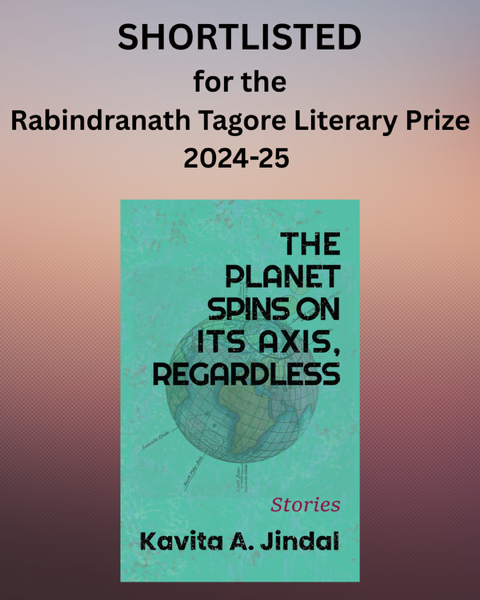
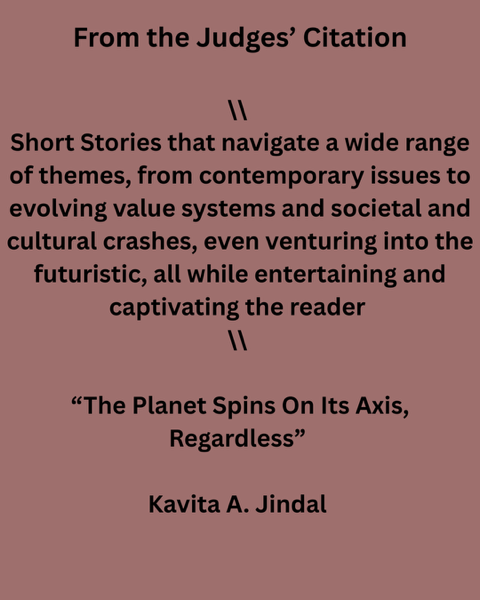
Good happenings in December 2025. Ended the year on a high note as “The Planet Spins On Its Axis, Regardless” was shortlisted for the Rabindranath Tagore Prize and also was a finalist for the Eyelands Prize.
I didn’t win either award, but the wonderful and incisive reviews from readers across many platforms — book blogs, Goodreads, netgalley, Amazon, personal emails etc. — gave me much joy. And also made me think again about how much readers bring of themselves to a story and how anything you publish is not really yours any more. It’s open to interpretation, as it should be.
I also had my very first Kirkus Review earlier in the year. Here is an extract:
“A spirit of philosophical inquiry infuses the collection, which provides impressively subtle psychological character portraits.
Indeed, this is the principal strength of Jindal’s stories: to show how the deeply eccentric is an everyday feature of human life.
A thoughtful anthology that offers an insightful peek into the oddities of human experience.”
The Planet Spins On Its Axis, Regardless
New Book

Delighted to introduce my collected short stories published by Serving House Books.
Meet the inventor of pre-conception contracts. The foodie high roller. The menopausal student shamans. The young window cleaner. The aspiring philosopher. The people taking it one-day-at-a-time.
These astute and prescient stories zigzag from England to India, from Europe to Hong Kong, and from the past to the future. As they traverse youthfulness to late life and everything in between, fault lines trip the characters, revealing rifts and the gift for resolutions.
‘If the skill of constructing a short story can be tested anywhere it is in its final line, and Jindal has us right in the palm of her hand until the end.’
– Gabrielle Barnby in Riggwelter
Poem for International Women’s Day
For International Women’s Day, March 8, here is my poem ‘The Category’ from my book “Patina” published in 2019.

‘Manual For A Decent Life’ shortlisted for the Rabindranath Tagore Literary Prize 2021-22


Manual For A Decent Life is on the shortlist for the Rabindranath Tagore Literary Prize 2021-22. I am very pleased to be on this shortlist because of the ethos of this prize, which chimes with me, and the continuing importance of Tagore’s philosophy in our world.
JUDGES CITATION: Kavita A. Jindal cuts through all the relevant contemporary narratives and tells the story of Waheeda, a mother and a Muslim, who ventures into a world of politics in the midst of socially unprogressive mindset. In a time and place where every layer of society is patriarchal, each step Waheeda takes is a transgression of what defines her and soon enough her life is a battlefield with everything at stake, yet, what she stands to lose is not what she bargained for.
Manual For A Decent Life is a gripping read about what happens to a woman who, at her own peril, violates established patterns of what is proper, but remains resilient despite the enormity of sacrifice.
See more about the eleven shortlisted titles at https://www.tagoreprize.com/.
A New Portrait
Sitting still | gazing at the reddening acer | a poem running through my head | while the painter is busy with brushes and oils.
This painting was completed by Paul Wuensche in November as part of his series of portraits of writers and poets. A Telengana artisan silk sari provides the backdrop.


Detail from Portrait

Paul Wuensche at work