
Love Across A Broken Map
The many permutations of love from girl-crushes to gigolos, spanning Manchester to Mumbai.
Short Stories by The Whole Kahani

“Unique…thought provoking”
“A beautiful, moving and sometimes challenging collection of tales”
“Unsettling and delightful”
It’s hard to believe that this anthology was published two years ago in June 2015. And that it’s already a year since the eBook was released in June 2016.

Love Across A Broken Map has had great reviews, some of them wonderfully detailed, and ‘The Whole Kahani’ collective has been invited to read and hold workshops at several literary festivals.
We are in the midst of finalising our second anthology and are celebrating the various individual successes and books of our members.
If you haven’t yet read this “engaging volume that eschews stereotypical stories about the experience of the South Asian diaspora in Britain” then now is the time to order the book or download it.
Buy Love Across A Broken Map from Dahlia Publishing or Amazon.
Also available at the wonderful Daunt Books, Marylebone, London.
Kindle Edition (available in the UK, US, India, and worldwide)
Reviews of the anthology:
The Short Story
Byte The Book
Bookmuse
Desi Lekh
The Book Review India
Confluence Magazine
An extract from the beginning of James Holden’s review in The Short Story:
In one of the short stories in this collection by The Whole Kahani, a character is asked whether she feels English, British or Indian. ‘“Wholly of one culture? A bit of both? Disconnected from both?”’ To which the narrator responds:
‘“I think of myself as multifaceted, blessed. I am not A or B; I am A+B, I am lucky to draw the best from both cultures.”’*
This exchange underscores the central mission of The Whole Kahani, a collective of British fiction writers of South Asian origin, who aim to ‘give a new voice to old stories and increase the visibility of South Asian writers in Britain.
*story excerpt from ‘Three Singers’ by Kavita A. Jindal

The review goes on to state:
‘Three Singers’ by Kavita A. Jindal similarly inhabits a culturally specific space, telling the story of a pair of twin sisters who attend an Indian classical choir, but Jindal subverts this by locating the class in a London church. It’s also one of the only stories to explicitly address issues of identity, exploring what it means to be mixed race, as well as telling a touching story of twin sisters competing for love.
Read a Group Interview with members of The Whole Kahani at:
http://theasianwriter.co.uk/2016/05/love-across-a-broken-map/
More on The Whole Kahani here: http://www.thewholekahani.com/

A Poem for the month of May
// The day the gutters overflowed / I left Kotapuram Port //
I’ve dug out an old poem first published in 2012:
It was in May. The sky poured.
The day the gutters overflowed
I left Kotapuram Port.
Abandoned on the platform were black trunks and tan suitcases
forsaken to their drenching while the porters huddled
under the whipped red awning.
The long brown train awaited the flutter of the guard’s green flag
as with slick-wet hair, from the window I stared
at a shadow I thought was there.
Friends wrote after long silences to say they’d told you
I’d shed tears on a platform awash with water
Scraped on to the train and cried again.
It was too good not to repeat.
You were puzzled when you heard this
or that’s the version I received.
It wouldn’t have changed anything, you said
if you’d been there, if you’d spoken
It wouldn’t have erased the train timetable
or the date of leaving Kotapuram
If you’d said ‘best of luck in life, my friend’
or another farewell equally inane
I’d have lived exactly the life I have
it would all have panned out the same.
I would’ve left on the day the sky poured
the day the gutters overflowed
Even if you’d stood there
to say ‘Hello. Goodbye. I care.’
‘Tears?’ you’d asked, with perplexed brow when the story was repeated
of rampant lightning and umbrellas twisted by the storm.
Of the face squelched to the streaky window.
‘Tears, for what purpose?’
There were pillars on the platform
Posters on the pillars, imploring us to
Stick No Bills
The yellow of the posters was shiny-succulent, water-lashed.
The pillars were white and round, the sodden green flag was down,
the train slipped out, pulled away my stare,
away from the shadow I thought was there.
It was in May. The sky poured. The gutters overflowed.
I left Kotapuram behind. The trains ran on time.
First Published in The HarperCollins Book of Modern English Poetry [by Indians], edited by Sudeep Sen, July 2012;
Also published in The Yellow Nib, edition: Modern English Poetry by Indians, edited by Sudeep Sen, July 2012.

Reading the poem ‘It Was In May. The sky poured.’
At Stanza Springback at The Ship, Mortlake, May 2018.
Photo credit: Konstandinos Mahoney
As always, feel free to write in with your comments on this poem.
If you haven’t yet signed up to subscribe to updates on events and new work, please do so now. Emails are very occasional.
Scenes from Bucharest


Literature Translation Masterclasses, Bucharest University
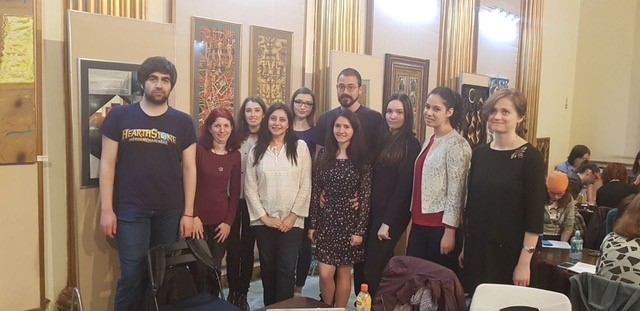
With my Student Group
The full programme and plenty of candid shots are available on Facebook at the Lidia Vianu’s Students Translate page.

Posing Poets: Peter Phillips, Caroline Carver, Anne Stewart, me, Dorothy Yamamoto


Prof. Dr. Lidia Vianu, Director of MTTLC
Bucharest in Spring & the Joys of Translation

On a drizzly spring day I’m looking ahead to next week in Bucharest teaching Literature Translation Masterclasses at The University of Bucharest.
I’ve been involved with the translation programme there since 2009 when I worked on polishing the English translations for some of the poems in the anthology “It Might Take Me Years” [Mi-ar trebui un sir de ani]. Then I worked on some of Dan Verona’s poems for the online publication of his selected poems in English, published in 2011 by Contemporary Literature Press. http://editura.mttlc.ro/
Three of my more recent poems, translated by Ana Maria Tone, were broadcast on Romanian Cultural Radio in 2015.
This will be my first visit to Romania. As I prepare to teach translation workshops I’m reminded of the lovely experience of Raincheck Renewed being translated into Romanian by Patricia Neculae, then a student at the MA Programme for the Translation of the Contemporary Literary Text (MTTLC) at the University of Bucharest. Not being able to speak a word of Romanian, I was no help, of course.
Here’s the link to the translation: http://revista.mttlc.ro/116/index.html
[If you are fluent in Romanian, do email and tell me how it reads/sounds in your language.]
Alina Popa, another MTTLC student, also translated a few poems from Raincheck Renewed for the magazine Regatul Cuvantului in February 2012. I haven’t compared the translations. You can see Alina’s translations here.

I’ll post details in a day or so about the new English-Romanian anthology of work by the visiting delegates (that’s me and my fellow writers) and the launch events planned for our week in Bucharest.
But first, my thanks to all these institutions and people for making our visit possible:
Prof. Dr. Lidia Vianu, Director, MTTLC and Contemporary Literature Press
Anne Stewart, http://www.poetrypf.co.uk/poetrypro.html
National Museum of Romanian Literature, https://mnlr.ro/
University of Bucharest, http://en.unibuc.ro/
Romanian Cultural Institute, http://www.icr-london.co.uk/; http://www.icr.ro/
British Council In Romania, https://www.britishcouncil.ro/en
100 Great Indian Poems
// how many paise for each brown glass bottle, how much for each tin can //

I’m delighted that my poem Kabariwala features in “100 Great Indian Poems”, now available to order. This anthology is unique for its selected translations of Indian poetry in 27 languages spanning 3000 years of literature.
Kabariwala is one of the few poems written originally in English.
The book is edited by Abhay K and published by Bloomsbury India.
You can read an extremely well-researched and well-written review of the book at DesiBlitz. The article includes an interview with me about the story behind this poem: https://www.desiblitz.com/content/100-great-indian-poems-poetic-feat-feast.
Last gig for 2017 at the Yurt Salon on 21 November

Free, but booking required. Reserve your place here: https://www.eventbrite.co.uk/e/winter-warmers-stories-about-love-imperfect-by-the-whole-kahani-tickets-38622140863